Data-Driven Fouling Prediction in Heat Exchanger Networks
Machine learning outperforms calendar-based schedules at predicting heat exchanger fouling.
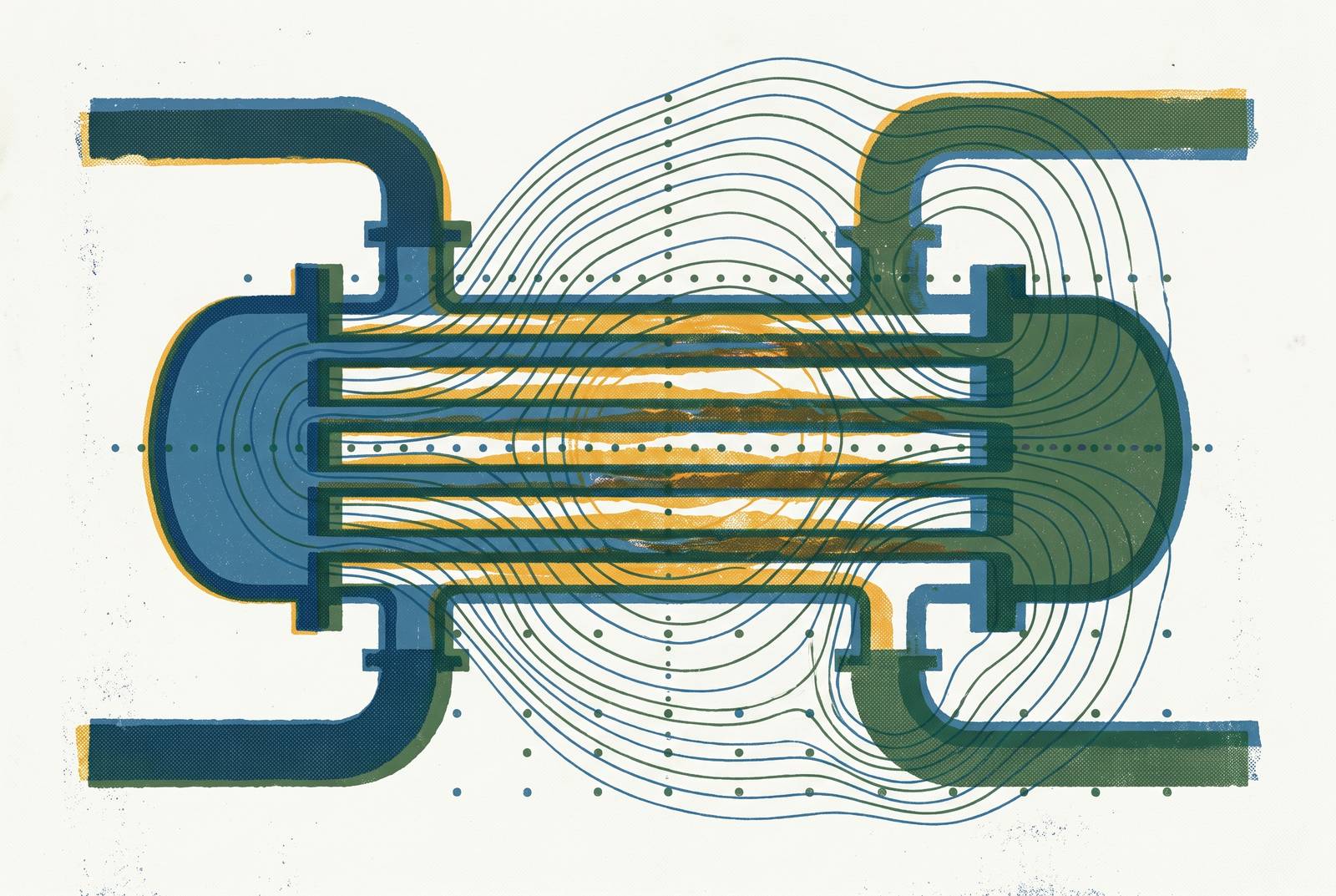
Fouling is the slow buildup of unwanted deposits on heat transfer surfaces, and it costs the energy industry billions of dollars a year in wasted fuel and unplanned maintenance. Over the past decade, machine learning has started to replace the guesswork in fouling prediction, pulling patterns out of operational data that older, static models simply can't see. The core argument here is blunt: calendar-based cleaning and single-metric monitoring are wrong tools that either waste downtime on units that don't need it or let real efficiency loss run past a scheduled shutdown. They're wrong tools that either waste downtime on units that don't need it or let real efficiency loss run past a scheduled shutdown.
Fouling itself isn't one phenomenon. The literature recognizes six distinct mechanisms: crystallization or scaling, particulate deposition, chemical reaction fouling, corrosion, biofouling, and solidification. In practice, two or more usually operate at once, layered on top of each other in ways that make the deposit's makeup and growth rate hard to pin down. Formation follows a five-stage sequence: an induction period, transport of foulant to the surface, attachment, removal, and aging. Each stage changes how fast the deposit builds and how it behaves thermally, and older prediction methods were never built to track a process with that many moving parts.
Refineries have historically leaned on four tools: empirical correlations, deterministic threshold models, calendar-based cleaning schedules, and computational fluid dynamics simulations. Each works in a narrow band of conditions and falls apart outside it, and calendar-based cleaning is the easiest failure to picture. It assumes fouling builds up at a roughly constant rate across every unit in a network, so operators clean on a fixed interval no matter what's actually going on inside the exchanger. Some units get cleaned early, wasting downtime and labor on a surface that wasn't dirty enough to matter yet. Others run past the point of real efficiency loss before a scheduled shutdown finally reaches them. Neither outcome is efficient, and both failures are baked into the method's central assumption, not incidental to it.
Empirical models fare a little better, but they still can't keep up with a plant that changes week to week. Crude oil shows why: it arrives contaminated with water, salt, wax, sand, and metal oxides, all in shifting proportions depending on the source crude and blend. A semi-empirical correlation built around a handful of fixed parameters cannot track that kind of compositional churn.
Refineries watching performance day to day run into a specific blind spot: they lean on a single aggregate number that can mask its own cause. Operators typically watch the overall heat transfer coefficient, UA, as a proxy for exchanger health. A drop in UA can come from fouling or from a drop in flow rate, and the two look identical in the aggregate number. Without a way to tell them apart, plant staff end up reacting to a signal that could mean two entirely different problems. Picking the wrong one means cleaning a unit that didn't need it while the real cause goes untouched.
A decade of ML research on fouling prediction
Two systematic reviews frame where the field stands today. A 2025 review published in ScienceDirect pulls together 51 articles going back to 2005, tracking key trends, limitations, and where the research is heading. A second review, published in Results in Engineering (Elsevier), narrows its window to 2016 through 2026 and covers 43 core studies, laying out a hierarchical taxonomy to organize the model types now in circulation.
Around the mid-2010s, interest in ML-based fouling prediction accelerated as empirical approaches kept falling short in complex networks and researchers began exploring data-driven alternatives. Across both reviews, the work spans a range of goals, from estimating fouling factors and thermal performance to supporting maintenance decisions and network-level optimization.
The model landscape: how the 2026 taxonomy organizes classical ML, deep learning, and hybrid approaches
The 2026 review's taxonomy splits the field into two top-level branches: non-hybrid models, covering classical machine learning and standalone deep learning architectures, and hybrid models, which combine two or more approaches into one framework.
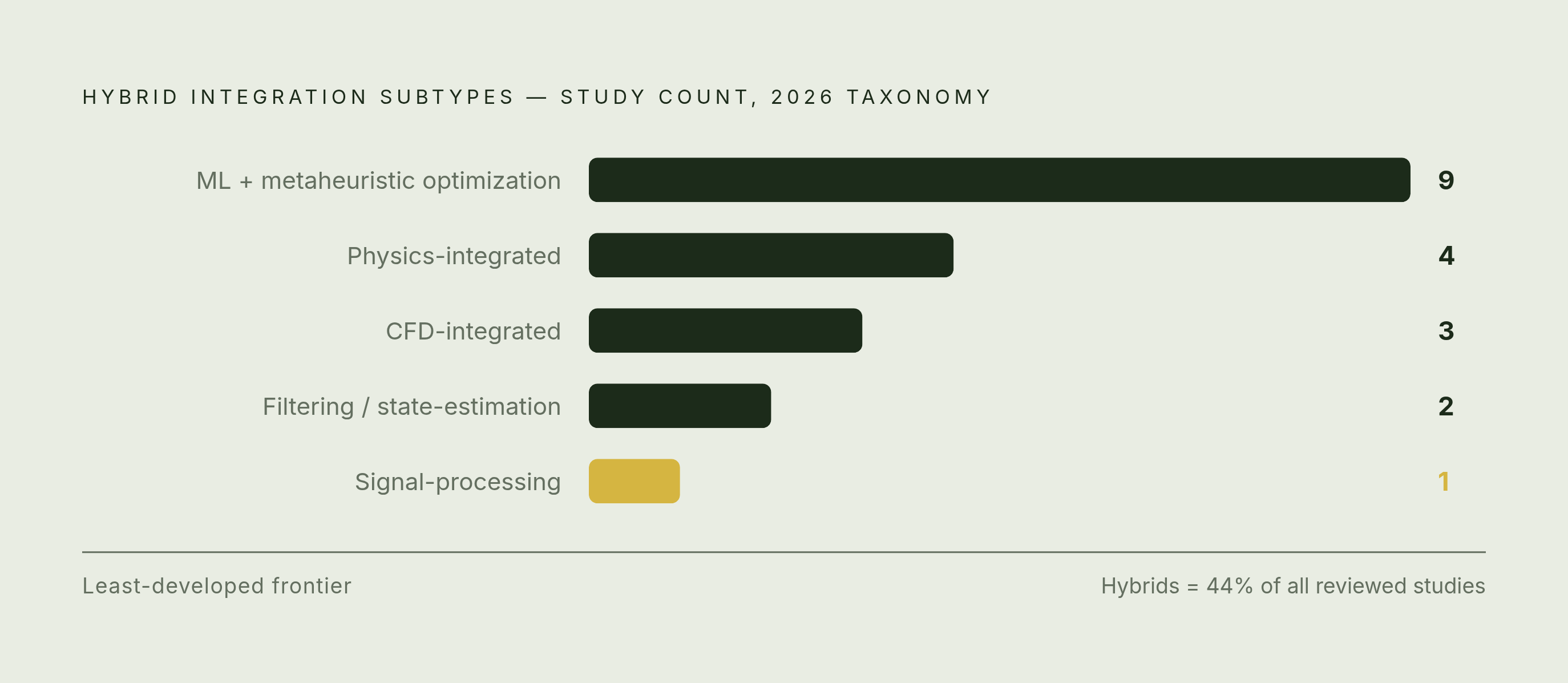
Non-hybrid models still make up most of the reviewed studies, which tracks given how much longer they've been around and how much easier they are to stand up with limited engineering overhead. But treating hybrids as a fringe experiment misreads the data: they account for 44% of the studies reviewed, close enough to the majority that a model built on a single architecture is probably missing behavior a hybrid approach would catch.
Within the hybrid category, the taxonomy identifies five integration subtypes, and they aren't evenly developed. ML paired with metaheuristic optimization is the most common setup by a clear margin, showing up in 9 of the reviewed studies. Physics-integrated hybrids follow at 4 studies, CFD-integrated approaches at 3, and filtering or state-estimation-assisted models at 2. Signal-processing-assisted hybrids appear in just 1 study, making them the least developed subtype in the taxonomy and an area with limited published work.
Performance of specific architectures: LSTM, gradient boosting, CNN hybrids, and physics-informed variants
Many models in this space share a common underlying logic: learning a clean baseline from operational data and using deviations from it as a fouling signal. The model trains on clean operational data to learn what a healthy exchanger's temperature and flow relationships look like. Once deployed, any gap between the model's predicted outlet temperature and the actual reading becomes the fouling signal, and fouling resistance gets calculated by comparing predicted and actual heat transfer coefficients.
Long short-term memory networks (LSTM) consistently deliver high accuracy tracking dynamic operational trends, which makes them the right call when conditions shift often. Extreme Gradient Boosting (XGB) trades some of that accuracy for simplicity: it runs lighter but extrapolates poorly once conditions move outside what it's seen in training. The older semi-empirical ε-NTU method loses to both on fouling detection sensitivity, and it shows weaker fouling detection sensitivity in complex operating environments. The reviewed evidence suggests LSTM better handles dynamic conditions, while XGB offers a simpler alternative, and ε-NTU trails both on fouling detection sensitivity.
A CNN-BiLSTM-Attention hybrid built for composite fouling, cases where crystallization and particulate deposition happen at once, posted an R² of 0.9975 predicting cold-side outlet temperature. That beats a standalone LSTM at 0.9815 and leaves a basic multilayer perceptron at 0.8697 well behind. The attention mechanism adds a layer of structure to the hybrid that standalone architectures lack, contributing to its superior predictive accuracy. The same study introduces a Health Condition Value index, built from fouling thermal resistance, that fires an alert once a set threshold is crossed, turning a raw prediction into a maintenance decision an operator can act on.
A generalized deep neural network framework for fouling resistance in crossflow exchangers reports R² above 99% against analytically modeled data. That figure reflects performance against analytically modeled data, so it shouldn't be the number anyone leans on. The number that actually matters comes from the same study's ensemble-based module, which holds an R² around 86% even under 10% 3σ sensor noise. Accuracy on clean data is a demo. Accuracy that survives real measurement error is what matters in practice, and it's the number that should decide which architecture gets deployed.
What data these models need and what they predict
The input side of these models is unglamorous by design, and that's the point. Studies in this space commonly draw on standard process measurements such as inlet and outlet temperatures, flow rates, and pressures on both sides of the exchanger. These are standard process measurements widely available in industrial facilities, making the approaches accessible without requiring major instrumentation upgrades.
What comes out the other end varies more than what goes in. Outlet temperature deviation from the clean-baseline prediction is the most common proxy for catching fouling onset early. Fouling resistance, the thermal resistance of the deposit layer itself, is the dominant explicit target across the literature. Heat transfer coefficient degradation gets derived as a byproduct of the predicted-versus-actual gap. Remaining useful life is predicted less often, but it's arguably the most useful output when it is, as in the FT-LSTM transfer learning study, because it turns a thermal signal directly into a maintenance timeline. Fouling thickness and cleanliness factor sit at the opposite end: only 2 and 3 studies respectively across the entire 2016-2026 window bother with them, a gap that says more about how hard those quantities are to measure directly than about any lack of interest.
The virtual sensing framework is why historian data ends up being enough for most of these approaches. Once the model has learned what "clean" looks like, the residual, the gap between what it expected and what it sees, does the actual detection work. That logic has a limit, though: the ensemble-based module's R² fell to around 86% at 10% 3σ sensor noise, and an ML-CFD surrogate model dropped to an R² of 0.7615 at just 5% noise. Accuracy erodes fast once sensor quality slips, and most plants don't publish how often their sensors get recalibrated. That silence is exactly where the gap opens up between what these models claim on paper and what they'll actually deliver on aging field instrumentation.
Crude oil preheat trains as the dominant test case for network-level fouling prediction
Crude distillation units are among the most energy-intensive processes in a refinery, and the preheat train is where most of that energy gets spent before crude even reaches the distillation column. Crude has to climb from ambient temperature to roughly 370°C, passing through a long chain of heat exchangers along the way and recovering heat from hot product streams before it ever sees a furnace.
Crude oil is close to a worst-case fouling scenario, and that's why it dominates the test literature. It carries water, salt, wax, sand, mud, and metal oxides all at once, driving organic and inorganic fouling mechanisms at the same time with no single one in charge of the outcome. Preheat trains are where fouling is hardest to model with a single mechanism, which makes them the toughest proving ground a prediction method can face, and the one most worth trusting if a model holds up there.
The UA blind spot described earlier gets especially acute in a preheat train, because it's a network, not a single unit. Fouling or a flow change in one exchanger ripples through the readings on every exchanger downstream, so isolating which unit is actually the problem turns into a puzzle involving every exchanger in the train, not a single-point diagnosis. That's the real argument for network-level models over unit-by-unit monitoring: a method that only watches one exchanger at a time is structurally blind to where the fouling actually started.
Where the research still falls short: generalization, data scarcity, and interpretability gaps
Generalization is the field's most persistent weakness, and it undercuts a lot of the reported accuracy in this literature. A model trained on one refinery's crude slate, one exchanger geometry, one set of flow conditions, tends to perform worse the moment it's asked to predict fouling somewhere else. That's not a minor inconvenience: it means the headline R² numbers in most of these studies describe performance in a narrow, specific setting rather than a capability that actually carries over across plants.
Data scarcity compounds the problem. Fouling events, especially severe ones that force an unplanned shutdown, are rare against the volume of routine operational data a plant generates day to day. Training a model to recognize the onset of something it's seen only a handful of times is a harder problem than training it to reproduce a clean baseline, and that's part of why so few studies go after harder targets like fouling thickness directly.
Interpretability stays uneven across the model types in circulation. Gradient boosting methods offer some visibility into which input features are driving a prediction. Deep architectures like LSTM and CNN hybrids, even with attention mechanisms bolted on, still function largely as black boxes to the engineers who have to act on their output. Telling an operator a threshold has been crossed isn't the same as telling them why, and closing that gap between prediction and explanation is where the field's next real work has to happen.
Sources
- Data-driven fouling prediction and health monitoring of plate heat exchangers based on accelerated fouling experiments and deep learning models | Journal of Thermal Analysis and Calorimetry | Springer Nature Link
- Data-Driven Fouling Detection in Refinery Preheat Train Heat Exchangers Using Neural Networks and Gradient Boosting | MDPI
- Machine learning for heat exchanger fouling prediction: A systematic review of hybrid and non-hybrid approaches for model selection - ScienceDirect
- (PDF) Artificial intelligence in industrial heat exchanger fouling prediction: A 20-year systematic review of AI, ML, and DL approaches
- MLP-based dynamic fouling prediction and health monitoring for energy-efficient operation of plate heat exchangers in smart heating systems - ScienceDirect
- sciencedirect.com
- mdpi.com