Multi-Objective Optimization of Energy and Yield in Distillation Columns
Engineers use competing objectives to escape the energy-yield tradeoff.
Distillation columns burn more energy than any other unit operation in chemical processing. Chemical separations eat up roughly half of a country's industrial energy use, and distillation drives most of that number. That single fact is why multi-objective optimization, MOO, has stopped being an academic exercise and become an operating necessity: you cannot chase energy savings and yield gains with the same knob, on the same axis, and expect both to improve. Something has to give, and the whole point of MOO is to put that tradeoff on the table instead of burying it inside one cost number.
The tradeoff between energy and yield inside a distillation column
A distillation column separates components by exploiting differences in volatility, pushing vapor up and liquid down across a series of trays until each stream hits the purity a plant needs. That separation depends on vapor-liquid equilibrium, reflux behavior, reboiler duty, and tray-by-tray mass transfer all working together. The column gives an engineer real dials to turn: tower pressure, feed temperature, reflux ratio and flow rate, reboiling ratio, distillate flow rate, and the number of trays itself.
Turning any one of those dials to gain yield tends to cost energy somewhere else. Most people miss that a column is not one tunable machine but a set of coupled tradeoffs. Raise the reflux ratio and separation gets sharper, but reboiler duty climbs right along with it, since more liquid has to be boiled and recondensed to keep that reflux flowing. Dropping the pressure shifts relative volatility in ways that ripple through every downstream tray, sometimes helping separation and sometimes just moving the problem to a different part of the column.
None of this is fully mapped out, either. How mass transfer actually behaves in space and time under dynamic operating conditions remains an open scientific problem, not an engineering inconvenience waiting on better instruments.
How multi-objective frameworks replace single-objective optimization
For decades, process optimization treated total annual cost, TAC, as the only number that mattered. It became the default because it collapsed a messy engineering problem into a single figure a plant manager could sign off on without asking too many questions.
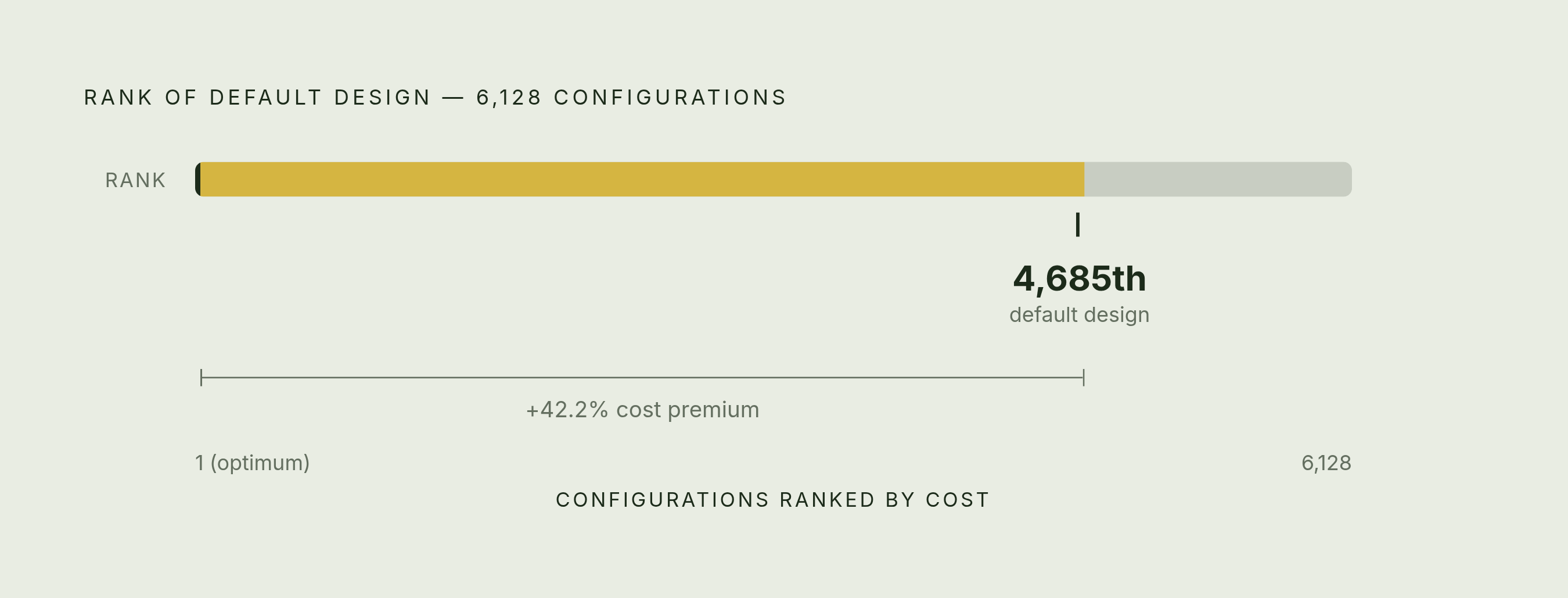
That approach fails because the most energy-efficient column design is rarely the cheapest one to build and run. Squeezing out more efficiency usually means more complex internals or a larger column diameter, and the capital tied up in those changes can swallow whatever the plant saves on utilities. A five-component case study makes the point bluntly: the best "sharp split" design, the configuration most engineers would reach for by default, ranked 4,685th out of 6,128 possible configurations and cost 42.2% more than the global optimum. That's the price of optimizing one objective inside one design paradigm and assuming the answer generalizes to every plant that adopts it.
Multi-objective optimization drops the search for a single best answer and works with a Pareto front instead: a set of solutions where improving one objective, energy consumption, say, necessarily makes another, yield or capital cost, say, worse. No solution sitting on that front is wrong. The engineer picks the one that fits the plant's actual priorities, and that's a different task entirely from asking an algorithm to hand back "the answer."
Evolutionary and metaheuristic algorithms: how they search the Pareto front in practice
NSGA-II and its successor NSGA-III do most of the heavy lifting here, using non-dominated sorting alongside diversity mechanisms to build out a full Pareto front rather than converge on one point. NSGA-III has been applied to a mixed xylene hybrid distillation/crystallization system through a Python-Aspen platform, paired with an online crystal monitoring tool that keeps the optimization grounded in real process behavior instead of pure simulation.
The Multi-Objective Grey Wolf Optimizer, MOGWO, has been applied to propylene distillation column optimization using plant operating data. Sensitivity analysis on tower pressure, feed temperature, and reflux flow shaped the optimization model, and a penalty function mechanism combined with a dynamic search factor kept the algorithm from wandering into infeasible territory. Production went up and energy consumption went down at the same time, on a real industrial unit, not a toy problem built to make an algorithm look good.
A genetic algorithm applied to TAC minimization solved a complex mixed-integer formulation and converged to a TAC of 1,679 USD per ton against a validated base case of 1,725 USD per ton. It also cut energy intensity by 262 kJ/kg while holding mass efficiency steady, which matters because it shows the savings came from the process itself, not from quietly shifting cost somewhere the metric doesn't look. Particle Swarm Optimization, applied to a reactive-extractive dividing wall column, cut TAC by 46.01% in the same run.
Different algorithms and different columns point to the same cause: existing optimization methods leave real headroom in configurations plants already call "optimized," because optimizing against one objective, cost, almost always leaves energy or yield sitting on the table, as every algorithm above proves." That word deserves the quotation marks. Optimizing against one objective, cost, almost always leaves energy or yield sitting on the table, and every algorithm above proves it.
Surrogate models and machine learning as a path to faster, broader optimization
Rigorous MESH equation solvers, the coupled material balance, equilibrium, and heat equations that describe a column tray by tray, are expensive to run. A single operating condition can be computationally expensive to simulate, which makes real-time optimization, or any search that needs to check thousands of candidate solutions, a nonstarter if it has to call the full simulator every time.
Surrogate models are the fix the field settled on: train a fast approximation on simulation output, then run the optimization against that approximation instead of the real thing. That approach is well established in chemical process engineering, but it has historically been narrow, tied to one specific chemical system and useless the moment the feed composition changes.
What's shifting now is the reach of a single surrogate. Instead of building a new model for every column, researchers have trained machine learning models that generalize across column specifications and across the entire chemical space of homogeneous ternary vapor-liquid mixtures, using a new representation of the model fluid built with one model trained on datasets exceeding one million samples. Reusability is the advance: one model doing work that used to require a fresh model for every case.
Reliability matters as much as speed. A self-adaptive Kriging model combined with a modified firefly algorithm, applied to prefractionation column optimization, produced a relative standard deviation of just 0.037% in final profit across 30 independent runs, against 0.266% and 0.237% for benchmark methods. That tighter spread is the real story. A plant won't adopt an optimization method that gives a different answer every time it runs, no matter how good that method looks on its best day.
Graph neural networks and real-time decision systems for dynamic column operation
Conventional data-driven models treat each tray as an independent data point, ignoring how mass and heat transfer actually move between neighboring trays. That shortcut produces prediction errors exceeding 10%, tolerable for offline design work, useless for anything running in real time.
Graph neural networks fit distillation columns almost too naturally. Trays become nodes, the flows between them become edges, and the network inherits the column's physical structure instead of flattening it into a generic table of numbers.
A Dynamic Spatiotemporal Graph Convolutional Network, DST-GCN, proposed in Chemical Engineering Research and Design by Jin, builds on that structure with heterogeneous node encoding that keeps tray states and component properties distinct, a dynamic adjacency matrix that tracks how energy transfer shifts over time, and orthogonal convolution with regularization to keep training stable. Edge computing lets the system respond in milliseconds. Tested on ethylene and methanol separation, it improved purity control, cut steam and power use, and hit 92% fault detection accuracy. Earlier GNN work on reaction pathways showed energy reductions around 15%, a rough sense of the range this class of model operates in.
Process intensification through dividing wall columns as a structural lever on the tradeoff
Dividing wall columns attack the energy-yield tradeoff structurally instead of algorithmically. Instead of two conventional columns in series, a DWC uses a single vessel split by an internal wall, cutting energy use, capital cost, and plot space at once, with no optimizer running in the background needed to get there.
This isn't emerging technology, and treating it as some new frontier misses forty years of operating history. BASF built the first commercial DWC in 1985 working with MONTZ, and a significant number of DWC installations now run worldwide, with ternary separation representing the industrially established application. Field data from Burns & McDonnell puts the savings at up to 40% less energy, compared to conventional column trains.
Multiple dividing wall columns, mDWCs, push the concept further, with the 30–50% energy savings range spanning standard DWCs through mDWCs across both capital and operating expenditure. Quaternary mixture separations using this approach are still stuck at pilot scale, though. Ternary separation is the version that's actually industrially established today, and anyone pitching quaternary mDWCs as ready for a grassroots plant is ahead of where the technology stands.
Choosing an operating point from the Pareto front: decision-support methods and engineering judgment
A Pareto front is an output, not an answer. Handing an engineer fifty non-dominated solutions solves nothing until someone decides what matters more: energy, cost, or emissions.
The literature offers formal ways to make that call. TOPSIS, the Technique for Order of Preference by Similarity to Ideal Solution, appears in combined frameworks alongside evolutionary algorithms such as NSGA-II. Weighted-sum scalarization and min-max approaches also appear in the literature, each one a different way of encoding what the plant actually cares about into a single ranking.
The 4E GEMD case study shows what this looks like on the ground. Two solutions stood out from the Pareto-optimal set: a "balanced" option delivering a 40.16% reduction in total energy consumption and a 9.47% reduction in TAC, against an alternative that cut energy further but drove TAC up more sharply in exchange. Which one wins depends on the plant's energy mix, regional carbon pricing, and how much capital is sitting around waiting to be spent, not on which algorithm generated the front. The optimal operating point will vary by plant context, and translating the Pareto front into a definitive site-specific economic answer remains a judgment call rather than a solved algorithmic problem.
A structured optimization workflow end to end
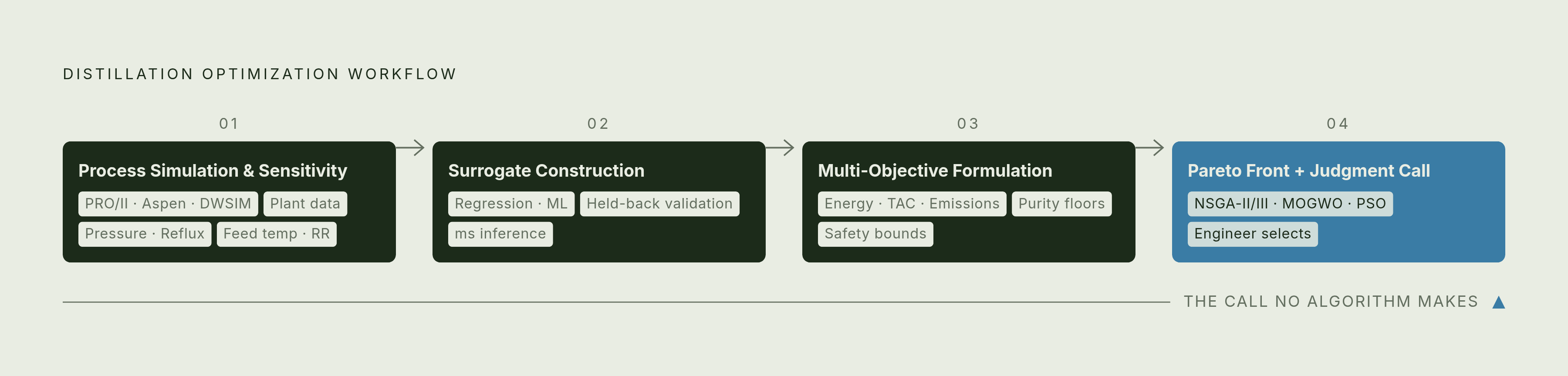
Start with process simulation and sensitivity analysis. Build a calibrated model, whether in PRO/II, Aspen, DWSIM, or an equivalent platform, using actual plant operating data rather than textbook assumptions, and run sensitivity analyses on tower pressure, feed temperature, reflux flow, and reboiling ratio, individually and in combination, before touching any optimization algorithm.
Move to surrogate construction next, needed wherever rigorous simulation is too slow to sit inside an optimization loop. Fit regression models or ML surrogates on the simulation output, validate them against operating points held back from training, and push for inference times measured in milliseconds so the surrogate doesn't turn into the bottleneck it was meant to remove.
Then formulate the problem as genuinely multi-objective. Define the objective functions, total energy consumption, TAC, emissions, exergy, and specify the constraints: purity floors on the product, equipment limits, and safety bounds that can't be crossed no matter what the optimizer suggests. Decide early whether structural variables like tray count, column count, or wall configuration stay open for the algorithm to change, or get fixed by engineering judgment before the search even starts.
Finally, select the algorithm and generate the Pareto front. Choose NSGA-II or NSGA-III for established multi-objective search, MOGWO or PSO where the problem calls for different search behavior, and a surrogate-backed loop wherever speed is the limiting factor. What comes out the other end is the starting point for the judgment call described above, the one no algorithm can make on a plant's behalf.
Sources
- Research on multi-objective energy-saving optimization of propylene distillation column - Tao Liu, 2025
- Energy, exergy, environment, and economic (4E) analysis and multi-objective genetic algorithm optimization of an energy-saving and carbon-reducing electrification ethylene glycol multiple-effect distillation process - ScienceDirect
- Optimization model of distillation tower operation based on graph neural network: Real time decision system for multi component separation - ScienceDirect
- Optimization-based design of structure and operation parameters simultaneously for real-world distillation column based on rate-based model - ScienceDirect
- Sustainable process design and multi-objective optimization of efficient and energy-saving separation of xylene isomers via extractive distillation based on double extractants - ScienceDirect
- Modeling and validation of multi-objective optimization for mixed xylene hybrid distillation/crystallization process - ScienceDirect
- sciencedirect.com